
Welcome...

...to cinematic opinions of Jack Kirby. Expect wit, wisdom and irregular updates.

Search This Blog

Sunday, 17 June 2012

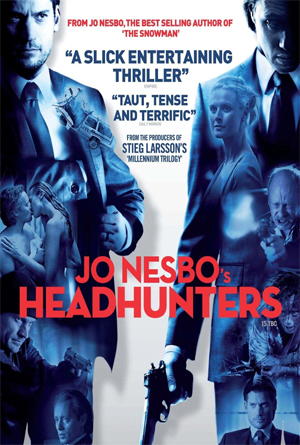
Headhunters Review


My only prior knowledge of Jo Nesbø was that posters for his books seemed to crop up on the underground with alarming rapidity a couple of years ago when The Girl with the Dragon Tattoo series’ popularity peaked. Clearly, I thought with cynicism, some wily publisher is cashing in on the current interest in Scandinavian literature. Of course, that meant it was only a matter of time before Nesbø’s work started appearing on screen too. I hadn’t learnt any more about Nesbø between noticing those posters and prior to the screening ofHeadhunters (until writing this review, I had assumed Nesbø was a woman), other than that there is, apparently Nesbø-themed pornography urbanely entitled ‘Jo Lesbo’.
So I had little to no expectations going into Headhunters. The story follows an executive recruiter (or ‘headhunter’), the decidedly un-Norwegian sounding Roger Brown, a man with a Napoleon complex  who has blagged his way into a comfortable life, a big house and the arms of a woman he considers out of his league, his wife Diana (Lund). Unfortunately, in order to make ends meet, Brown has found it necessary to earn additional income through less than legal means and, along with his somewhat inane partner in crime Ove (Sander), has become an art thief. When he discovers that his latest mark, the impressive Clas Greve (Coster-Waldau), is apparently sleeping with Diana, Brown sabotages Greve’s chances of landing a top position at a GPS company. However, Greve is a former soldier and begins seeking revenge on Brown, starting a deadly game of cat and mouse. The Gordian plot only gets knottier from hereon in.
Headhunters was an absolute treat. Its black as night humour, clever plotting, strong characterisation and bouts of extreme violence were straight up my street. Headhunters is essentially a Scandinavian Coen Brothers film (think FargoBlood Simpleand Burn After Reading), which is, of course, a very good thing. Whilst the casual violence and sense of meaninglessness of the Coens are present in Headhunters, there’s also a level of sincerity and pathos underneath the ridiculousness of the events film.
Much of the film’s success is due to Aksel Hennie’s outstanding central performance as Brown. Hennie’s character has a bizarre mixture of resourcefulness and stupidity about him and scuttles about the film, looking like the strange lovechild of Steve Buscemi and Alan B’stard. The role requires an awful lot of him (not least a fantastic Trainspotting/Slumdog Millionaire WC moment) and Hennie does more than justice to it. Brown is something of a creep and frequently unpleasant; it’s indicative of Hennie’s quality that we root for his character nonetheless.
Arguably, the intricacies of the plot do not quite hang together – it may require multiple viewings to make sure, but other than that, Headhunters is an exceptionally good film. Cast any lingering associations with The Girl with the Dragon Tattoo straight out of your mind, if indeed you had any. This is a completely different kettle of fish. Surprising, exciting and frequently hilarious, Headhunters is riotously entertaining and definitely worth seeking out. It also contains the best dog death in any film this year so far.

The Pirates! in an Adventure with Scientists Review


There are a few things in cinema that can be described as a safe bet. One is a Chris Nolan film is probably going to be pretty good. Another is Jeff Bridges being extremely watchable in anything he’s in. You can also add an Aardman production almost always being a good thing to that list.
The folks who brought you Wallace and Gromit and Chicken Run have opened their plasticine kit once more to bring us a nautical but nice pirate adventure, with added scientists. Hugh Grant voices the logically named Pirate Captain, whose sole ambition is to at last win the coveted Pirate of the Year Award. After a chance encounter with Charles Darwin, he realises his best chance of plundering enough booty to impress the judges is to use his trusty pet dodo Polly to win the Royal Society’s similar Scientist of the Year prize money, whilst avoiding the infamously pirate-averse Queen Victoria.
Like Arthur Christmas before it, Aardman have assembled an excellent cast to voice their clay models. The on-form Grant heads up the talent, flanked by David Tennant, Imelda Staunton and Ashley Jensen, to name but four. There’s also Salma Hayek, Jeremy Piven, Martin Freeman, Lenny Henry, Brendan Gleeson and Brian Blessed to name six more.
Similarly to the recent Muppets reboot (we’re being rather spoilt for decent family-fare at the moment it seems), the strengths of The Pirates! are in its audience-spanning appeal and its frighteningly consistent laugh rate. Gideon Defoe’s script, an adaptation of his own tongue-in-cheek novel, is responsible for a great deal of humour, but as we’ve come to expect from Aardman, there are also hundreds of sight gags littered throughout the film, meaning you’re never waiting more than several seconds between giggles. The humour is pitched perfectly to please both sprogs and grown-ups. Defoe’s series of Pirates!books are primarily aimed at adults in the first place and their deep sense of irony and wry humour has not been lost in transition to the screen. Thankfully though, kids are highly unlikely to be alienated or left out by the jokes and the film is without the air of smugness that pervades such ‘a bit of blue for the dads’ films like the Shrek franchise.
Credit has to be given to Aardman for how visually stunning the film is. The level detail in the models is astounding and watching the whole thing in motion is a feast for the eyes. I’m not normally one for re-watching films, but I’d make an exception for Pirates! firstly to try and catch the jokes I missed the first time around and secondly simply to marvel at the incredible attention to detail the film boasts.
This is the part of the review where I’d normally mention a few detracting aspects of the film, but for the first time in ages, I don’t think I can name a single thing I didn’t like about the film. Given the choice, I’d see it in 2D, but that’s just a personal preference. The Pirates! is a wonderful achievement that deserves every success. You timbers will be well and truly shivered.

Machine Gun Preacher Review


As you are probably and unfortunately aware, Machine Gun Preacher is not the tale of a man of god that takes to the mean streets of LA armed to the teeth to deliver some righteous justice and stick it to the man. Along with Hobo with a Shotgun, it’s one of the best exploitation titles you could hope for. In real life, however, Machine Gun Preacher is the true story of Sam Childers, former hell-raising bad-boy, who, after the kind of epiphany only brought on by stabbing a homeless person half to death, turns to Jesus. After seeing the light, Sam begins working in Sudan, caring for the orphans of the war zone.
The DVD release of Machine Gun Preacher is timely, given the recent internet outcry over Kony 2012. The backlash against that video (and to some extent the ‘panning’ Machine Gun Preacher received on its release) is somewhat aggravating; is it important how and why people are made aware of real world issues as long as they are made aware in the first place? The humanitarian disaster happening in Sudan right now is appalling and Machine Gun Preacher should at least be applauded for its largely unflinching and mature portrayal of the crisis.
It isn’t the point of a review to judge how worthy a film’s subject matter is though, and the narrative itself can be somewhat plodding. It also takes director Marc Forster over two hours to tell a story that is in real life on-going, meaning that it’s both overlong and inconclusive. And while Gerard Butler gives a generally rather mature and focused performance, his wild man act at the beginning of the film feels somewhat more like a caricature than a portrayal. Towards the end of the film however, things do get interesting as Sam begins to undertake his mission more aggressively, to the detriment of both his family and his new-found faith.
There’s also able support in the form of Michael Shannon and Michelle Monaghan and Madeline Carroll (whom sharp-eyed readers will recognise as creepy Ben’s childhood sweetheart Annie from Lost) is also rather good as Sam’s daughter.
Machine Gun Preacher is a much more challenging and occasionally more interesting film than perhaps its title and the presence of Butler would suggest. It’s no must-see, but as a competent and sober depiction of a continuing travesty, it more than does its job.

Touching Home Review


Touching Home is a true story written and directed by Logan and Noah Miller about their relationship with their late father. With no previous experience of working in film and a budget of $2million (small beer in movieland), they have created an interesting and sensitive, if workmanlike film. Touching Home sees the twin brothers striving to break into professional baseball whilst dealing with their homeless and alcoholic father Charlie, played by an excellent Ed Harris.
Whilst the film is an impressive achievement in and of itself, though it pains me to say it, Touching Home is simply a little dull. It tends to meander and dwell too much where succinctness and implication would serve the film better and feels rather baggy around the edges. There’s a very televisual feel to proceedings, which marred my enjoyment somewhat.
That said, the cast are excellent. Alongside Harris, Robert Forster (probably best known for his brilliant performance in Quentin Tarantino’s Jackie Brown and currently appearing inAlcatraz) does himself proud as the town’s fatherly cop and the boy’s former coach. Credit is also due to Brad Dourif, who gives a sensitive performance as Clyde, Charlie’s brother with learning difficulties. Logan and Noah Miller, who play fictionalised versions of themselves, are also good.
Baseball is seemingly the medium required to tell the stories of American sons struggling to come to terms with the lives of their fathers. See also Field of Dreams and The Open Road. I’m not really a fan of the former (sacrilege to many, apparently) and I doubt the latter will have set many people’s world alight. Perhaps being British and only really caring about one sport that isn’t baseball makes it difficult for me to engage properly with these films. Touching Home may not reverse the trend I’ve just strung together of slightly ropey father-son baseball dramas, but heck, it’s at least as good as those other two and is much more authentic in its affectionate, yet honest portrayal of a deeply flawed individual.

Thursday, 22 March 2012

Albatross Review

Looking for a quirky, British, coming-of-age dramedy, that though far from rubbish, isn’t quite as good as it thinks it is? Then look no further than Albatross, the debut cinematic effort for both its director and its writer, Niall MacCormick and Tamzin Rafn.

The lives of a family on the Isle of Man are turned upside down and inside out when a new cleaner, Emelia, is hired to work at their hotel. Emelia is seventeen, precocious and belligerent. She befriends the family’s bookish elder daughter Beth and begins an affair with her father, one hit wonder novelist Jonathan and events inevitably spiral out of control.

The double act between Jessica Brown-Findlay (Emelia) and rising star Felicity Jones (Beth) is the film’s strongest asset. The scenes of friendship between these two capable young actors are well-crafted and believably performed. It’s pleasing to see a relationship between two female teenagers explored properly on screen – lord knows the ‘bromance’ genre is far from lacking in material, but it seems rare that we are treated to a mature take on the female equivalent. Brown-Findlay and Jones give excellent performances that promise great things to come for both of them.

Unfortunately, whilst the adolescent characters are satisfyingly created, the same cannot be said for the adults in the film. Sebastian Koch and Julia Ormond do the best they can with their roles, but their mum and dad characters are written with shockingly broad strokes. And for a film in which two characters discuss bad writing and weak metaphors, there are some terrible instances of both in Albatross. It also flirts dangerously with pretension.

Still, it’s possible to overlook the film’s inconsistencies and enjoy it as a fairly amusing and occasionally touching drama. Additionally, it deserves innumerable plaudits for its invention of the work ‘procasturbating’.

Friday, 9 March 2012

John Carter cast & crew interviews

On Saturday morning, I was invited to go to the Corinthia Hotel to take part in round table interviews with the cast and crew of the forthcoming John Carter. My previous experience of round table interviews suggested I’d probably get around twenty minutes at best with a couple of actors or crew members, but to my surprise, the assembled journos and myself were put into small groups and got a good twenty-five minutes or so each with Lynn Collins, Taylor Kitsch, Andrew Stanton, Willem Dafoe and the film’s producers, Lindsey Collins and Jim Morris.

That gave me more material than I could ever hope to transcribe in a weekend, so with that in mind, I’ve produced them as podcasts that you can listen to at your leisure, on your way to work, on the beach or even on the loo. Technology, eh? It’s brilliant. Not to pick favourites or anything, but meeting Dafoe was certainly a personal highlight and Stanton is very forthcoming too. Please enjoy.

Oh and just to add a little personal context to my day. As I was exiting the tube at Westminster I ran into none other than our wonderful and respected leaders, David ‘Cammo’ Cameron and Boris ‘Bojo’ Johnson. How about that, eh? Also, when leaving the hotel I inadvertently ducked into a lift with Taylor Kitsch and his assistants, whereupon their conversation promptly stopped short. I felt a bit awkward. Kitsch was really nice though and my mumbled, ‘good luck with the film’ seemed to be received well.

Taylor Kitsch:

Or download here

Lynn Collins:

Or download here

Willem Dafoe:

Or download here

Director Andrew Stanton:

Or download here

Producers Lindsey Collins and Jim Morris:

Or download here

Take Review

Prior to hitting it big with The Hurt Locker and propelling himself into superstardom/back into obscurity with the enormous success/spectacular failure of Avengers Assemble, Jeremy Renner starred in this fairly low-key drama about a man on death row and the woman he wronged. Minnie driver plays Ana, a woman struggling to make ends meet and raise her son, who has additional support needs. Renner plays Saul, a man whose gambling debts have force him into a life of crime. These two people’s lives collide in a dramatic, tragic and highly predictable manner.

The problem with Take is that for all its worthiness and decent performances, it is unfortunately very dull. I finished watching it not three hours ago and I’m already struggling to remember much of it. The Big Important Climatic Crime Scene is pulled off pretty well, but why does it come so late on, towards the final third of the film? The narrative is constructed in a nonlinear manner and it seems to me that to have The Big Important Climatic Crime Scene happen much earlier would have ultimately made me care more about the characters’ fates. It’s pretty obvious what’s going to happen anyway, so they might as well have got it other with.

The most interesting thing about the film is the title card at its end which discusses Restorative Justice, a charity that seeks to make criminals and victims and the public at large more aware of the human damage of crime and seeks to create meetings between criminals and victims to discuss their crimes to much great affect, apparently. This is all well and good, but personally it was difficult to sympathise too heavily with this cause whilst the film maintains an apparently nonchalant position on the death penalty, the abolition of which, I feel, is a much higher priority.

Still, at least Saul was humanised and while there was a certain amount of catharsis, there was no cut and dry resolution for the pair at the film’s end. It’s nice to watch a film with some thought behind it, so it’s a shame that Take is delivered so weakly.